

Look Under The Hood
Your $15,000 Watch May Have The Same Movement As a $3,000 One

Welcome to the wonderfully incestuous world of Swiss watchmaking, where competitors share engines, luxury conglomerates own the factories, and the words "in-house movement" deserve a closer look.
Here's a dirty little secret the luxury watch industry doesn't exactly advertise: that magnificent mechanical masterpiece on your wrist may have a lot more in common with a watch costing one-fifth as much than its manufacturer would like you to know.
Swiss watchmaking, where everybody competes with everybody, everybody seems to own a piece of somebody, and the company selling you a $15,000 watch might be buying its movement from the same factory supplying a $3,000 competitor.
Imagine Mercedes-Benz buying engines from BMW, which also supplies Audi, while Porsche owns a piece of the engine factory. Sounds ridiculous?

Look at the dizzyingly and complecated ownership chart below. What appears to be a collection of fiercely independent luxury brands is actually a surprisingly concentrated industry dominated by a handful of corporate groups.

The Swatch Group owns Omega, Longines, Tissot, Hamilton, Blancpain and Breguet, among others. It also owns ETA, one of the most important movement manufacturers in watchmaking history. For decades, ETA supplied the mechanical engines powering watches from brands both inside and outside Swatch Group. Eventually, Swatch decided it wasn't particularly interested in being everybody else's engine supplier.

That helped open the door for Sellita, whose movements now appear in watches from numerous competing brands. Take the Sellita SW200 family. Variations of this dependable Swiss automatic movement have powered watches from Sinn, Oris, TAG Heuer and Breitling. The watches may differ dramatically in price, but their basic mechanical ancestry can be remarkably similar.
Are they identical watches? Of course not. Cases, finishing, bracelets, regulation, water resistance and brand positioning all matter. But does a beautifully engraved rotor and an expensive advertising campaign automatically transform a relatively ordinary movement into haute horlogerie?
Hardly.
Perhaps the most fascinating arrangement involves Tudor, Rolex's sister brand.
Tudor established Kenissi in 2016 to manufacture movements. Chanel acquired a 20% stake in 2018, and Kenissi has supplied calibers to Breitling, Norqain, TAG Heuer and others. So Tudor's movement operation helps power watches sold by its competitors.
And it gets better.
Breitling has supplied its B01-family chronograph technology to Tudor, while Kenissi has supplied automatic movements to Breitling.
It seems that everyone is sleeping in everyone elses bed.
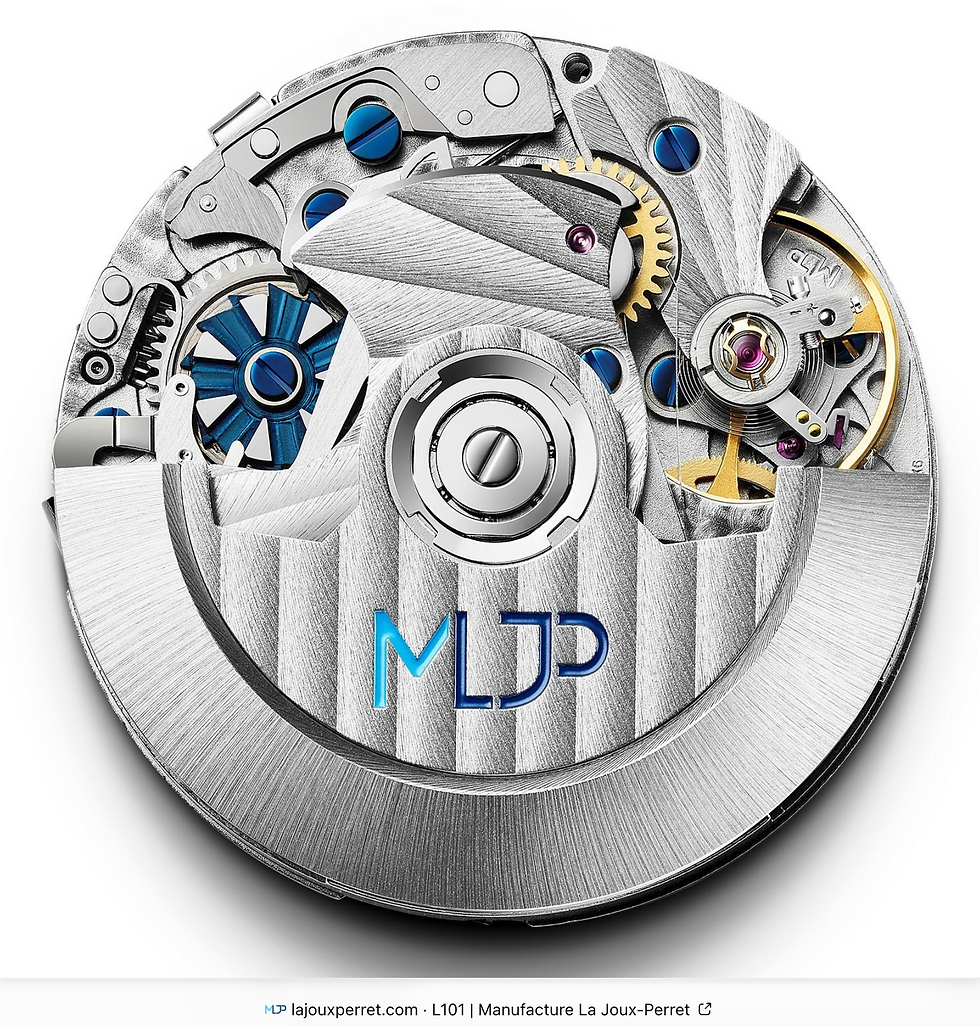
Then there's La Joux-Perret, a Swiss movement manufacturer owned by Japan's Citizen Group.
In November 2025, LVMH acquired a minority stake in the company, strengthening a relationship that already included supplying movements to TAG Heuer and Tiffany & Co.
Think about that. The conglomerate behind TAG Heuer, Zenith, Hublot and Bulgari invested in a movement company owned by another major watchmaking group.
This isn't corporate confusion. It's smart manufacturing economics.
Building mechanical movements requires expensive machinery, specialized engineers, skilled watchmakers and years of development. Selling movements to competitors spreads those costs across greater production volumes.
And that brings us to the industry's favorite marketing phrase. "In-house movement."
Swiss watch brands love those three words. They sound exclusive, important and expensive.
But what exactly does in-house mean when a movement is manufactured by a separate company owned by the same conglomerate? Or developed through a partnership? Or based on a platform also supplied to three competing brands?
Sometimes it means genuine proprietary engineering and production. Other times it means a group-owned supplier, an extensively modified third-party caliber, or a movement manufactured under an exclusive agreement.
Those distinctions matter. None of this makes a watch bad. Kenissi, ETA, Sellita and La Joux-Perret manufacture excellent movements. In fact, a proven, widely used caliber may be more reliable and easier to service than an exotic proprietary movement.

But we collectors deserve to understand what they're buying.
A $15,000 watch can absolutely justify its price through craftsmanship, complications, materials, design and finishing. What it cannot justify is pretending a shared industrial movement is some miraculous invention unavailable to the competition.
So the next time a salesperson proudly announces that a watch contains an exclusive manufacture movement, ask three questions:
Who actually manufactures it? Who owns that manufacturer? And which other brands use the same movement architecture?
You might be surprised by the answers.


Comments